The Most Valuable Data You'll Ever Collect Is Already Walking Out the Gate
Every attendee who leaves your event has a fresh, specific opinion about what worked and what didn't. They know which lines were too long. They know which set they wished had gone longer. They know whether they'll buy a ticket next year, and they know what their friends will hear about the weekend.
Most of that data never gets captured. Organizers either skip the post-event survey entirely, send one that's too long to complete, or collect responses and never act on them. Any of those outcomes leaves money on the table, because next year's marketing, pricing, and programming decisions should all be informed by what this year's attendees actually experienced.
A well-designed post-event survey closes that loop. This guide covers the full playbook: when to send, how to get high response rates, which questions actually matter, and how to turn the data into decisions that grow your event.
When to Send: The Timing Framework
Survey timing is a balance between two opposing forces: memory and motivation. Send too soon and your attendees are still tired, packing up, or driving home. Send too late and the details blur together. The sweet spot is narrower than most organizers realize.
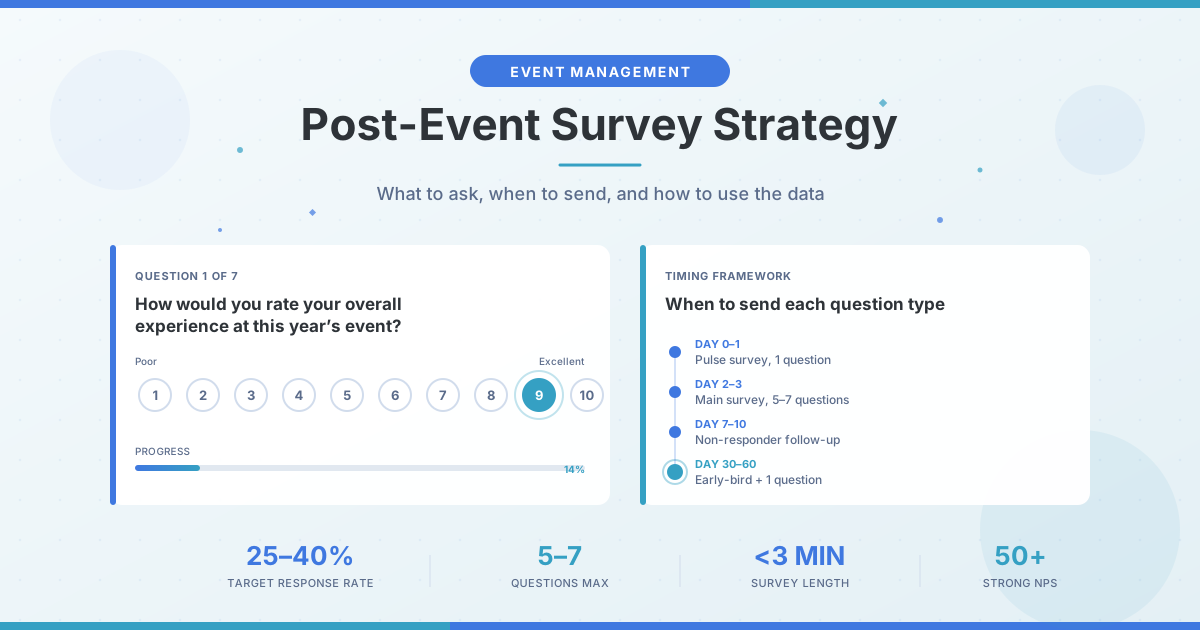
A timing framework that works for most festivals, concerts, and multi-day events:
- Day of event (evening) or day 1 post-event. Send a short "how was it?" pulse survey focused on a single open-ended question or an overall rating. This captures the emotional high point before memory fades.
- Day 2 to day 3 post-event. Send the main survey. Attendees have rested, the experience is still vivid, and you have their attention before life resumes.
- Day 7 to day 10 post-event. Send a short "would you come back?" follow-up to anyone who didn't complete the main survey. Frame it as a one-question ask.
- 30 to 60 days post-event. Send a "we're already planning next year" message with an early-bird offer and a single question: what would make you commit today? This is survey data plus a sales opportunity.
Don't wait two weeks to send your main survey. Response rates fall off a cliff after day five, and the quality of the feedback degrades even faster.
How to Get Higher Response Rates
Most post-event surveys land in the 5 to 15 percent response rate range. That's not great. With a few adjustments, you can reliably hit 25 to 40 percent for engaged event audiences.
What moves the needle:
- Keep it short. Five to seven questions, most of them multiple choice or rating scale. A survey that takes under three minutes will outperform a five-minute survey by a significant margin.
- Make the subject line specific. "How was [Event Name] 2026?" outperforms "We want your feedback." Attendees are proud of having gone; remind them of the experience, not the chore.
- Use a real sender name and address. An email from "John at [Festival Name]" outperforms an email from "[email protected]." People respond to people.
- Offer a meaningful incentive. Early-bird discount codes for next year's event, entry into a raffle for a premium ticket package, or merchandise credits all work. Avoid generic gift card raffles; tie the incentive to your own event ecosystem so the reward reinforces loyalty.
- Lead with the easiest question. Start with the 1–10 overall rating. Completion rates rise when the first action requires zero thought.
- Mobile-optimize the whole flow. Most responses come from phones. If your survey is painful on mobile, you've lost half your audience before they start.
Big Tickets lets you email ticket buyers directly from the event dashboard, so you can send post-event surveys to the same audience that purchased, segmented by ticket type, day attended, or any custom tag you've applied. For the survey itself, most organizers use a third-party tool (Google Forms, Typeform, or similar) and link to it from the email; the Big Tickets reporting suite then lets you tie responses back to buyer and attendance data when you analyze results.
The Question Templates That Actually Produce Useful Data
Every question in a post-event survey should earn its place. If you wouldn't change anything based on the answer, don't ask it. Here are the question types that consistently produce actionable data, with recommended wording.
1. The Overall Rating (The Anchor Question)
Question: "On a scale of 1 to 10, how would you rate your overall experience at [Event Name]?"
Always start here. It's zero effort for the respondent, it gives you a single number to trend across years, and it lets you route follow-up questions based on the answer. Low ratings (1–6) should trigger a different follow-up than high ratings (9–10).
2. Net Promoter Score (NPS)
Question: "On a scale of 0 to 10, how likely are you to recommend [Event Name] to a friend or colleague?"
Net Promoter Score is the most validated loyalty metric in existence, and it's a reliable leading indicator of repeat attendance and organic growth. Scores of 9–10 are promoters, 7–8 are passives, and 0–6 are detractors. Subtract detractor percentage from promoter percentage to get your NPS. For live events, a score above 50 is strong, above 70 is exceptional, and below 30 signals a real experience problem.
Track NPS year over year. It's a truer measure of event health than revenue alone.
3. The Open-Ended Follow-Up (Used Sparingly)
Question: "In one sentence, what was the best part of your experience?"
Or conversely: "What's one thing we could have done better?"
Open-ended questions get skipped more often than multiple choice, but the answers you do get are gold. One per survey, max. Position it after the anchor rating so respondents are already engaged.
A trick that improves completion: use "one sentence" or "one thing" in the wording. It signals that the answer doesn't need to be long, which reduces the psychological cost of starting to type.
4. Favorite Element
Question: "Which of the following was your favorite part of the event? (Select one)"
List 4 to 8 specific elements: headliner performance, craft beer selection, food vendors, specific stages or activities, late-night programming, VIP experience, kids' zone, etc. This tells you what to lean into for next year's marketing and production budget.
Avoid vague options like "the atmosphere" or "the vibe." Stick to things you can actually book, staff, or improve.
5. Friction Points
Question: "Which of the following (if any) created friction for you? (Select all that apply)"
List operational pain points: entry wait times, parking, food lines, restroom access, water availability, signage and wayfinding, mobile signal, sound quality, accessibility. This is the most operationally actionable question on the survey. If 40% of respondents flag food lines, you know exactly where next year's investment should go.
6. Attendance History
Question: "Is this your first time attending [Event Name], or have you been before?"
Follow-up options: first time, second time, 3–5 times, 6+ times. This single question lets you segment every other response by attendee tenure, which is one of the most valuable cuts of the data. First-timers often rate an event more generously but are also the most likely to churn. Long-time attendees give tougher ratings but are the backbone of your community.
If first-timers and veterans are rating the event differently, that tells you a specific story about what's changing year over year.
7. Pricing Perception
Question: "Thinking about what you paid for your ticket, the overall value was:" (Way too low / Fair / Way too high / Unsure)
Most organizers don't ask pricing questions on their survey, and that's a missed opportunity. Pricing is one of the highest-leverage decisions you'll make, and your attendees have an opinion. Track the results by ticket tier: if your GA buyers say "fair" but your VIP buyers say "way too high," you have a specific pricing problem to solve.
8. The Return Commitment
Question: "How likely are you to attend [Event Name] next year?" (Definitely will / Probably will / Not sure / Probably won't / Definitely won't)
This is a softer predictor than NPS but more direct. Track the percentage of "definitely will" respondents over time. If that number falls, something about the experience shifted, and you need to figure out what before tickets go on sale.
Questions to Avoid (or Ask Very Carefully)
Some questions feel reasonable but produce noisy or misleading data:
- Multi-part questions. "Rate the sound, lighting, and stage production" should be three separate questions, not one. Combined questions force respondents to average across dimensions, which loses all the signal.
- Leading questions. "How much did you enjoy our incredible headliner?" cues the answer. Ask "how would you rate the headliner's performance" instead.
- Questions that only make sense to staff. "How was the activation on the north lawn at 4 p.m.?" requires context most attendees don't have. Ask about broad elements instead.
- Demographic questions the respondent can't answer in good faith. Income, household size, and granular demographic breakdowns belong in a larger attendee research study, not a three-minute post-event survey. Save them.
Respect Response Bias (and Plan for It)
Post-event survey responses are always skewed toward people who felt strongly, usually positively. Someone who had an average time is less likely to respond than someone who had a great time or a terrible time. Your data will over-represent the edges.
A few ways to account for this:
- Look at absolute numbers, not just percentages. If 200 people say food lines were a problem, that's 200 attendees with a specific complaint, regardless of your overall response rate.
- Compare response rates across ticket tiers. If only VIPs respond, your data reflects VIP opinions, not the full attendee base.
- Triangulate with behavioral data. Your ticket sales, scan rates, concession revenue, and social media sentiment all add context to survey responses. When multiple sources agree, you can act with confidence.
Turn Responses Into Decisions
Collecting the data is only the first step. The surveys that actually improve events are the ones where responses get turned into specific, documented decisions.
A simple framework:
- Aggregate and segment. Pull responses by ticket type, attendance history, and rating tier. Look for patterns the overall average hides.
- Pick the top 3 issues. Don't try to fix everything. Pick the three highest-frequency complaints that are within your control, and build an action plan for each.
- Pick the top 2 wins. What did attendees love most? Those become marketing angles for next year's campaign and budget priorities for production.
- Document next year's changes. In the planning kickoff, reference the survey data explicitly. "Based on post-event survey data showing 38% of attendees flagged entry wait times, we're adding four additional scanning lanes and opening 30 minutes earlier." That's how data becomes decisions.
Surveys Are the Cheapest Research You'll Ever Run
There's no excuse for skipping the post-event survey. The tools are free, the audience is ready, and the insights compound year over year. The organizers who grow their events year after year treat the survey not as a chore but as the opening move for next year's planning cycle.
Keep it short, keep it specific, ask questions you'll actually act on, and send it within three days of your event ending. That's the whole playbook.
Ready to Run a Smarter Event?
Big Tickets helps festivals, fairs, concerts, and live events sell more tickets, streamline operations, and deliver a better attendee experience. No subscriptions, no setup fees.
Request a Demo