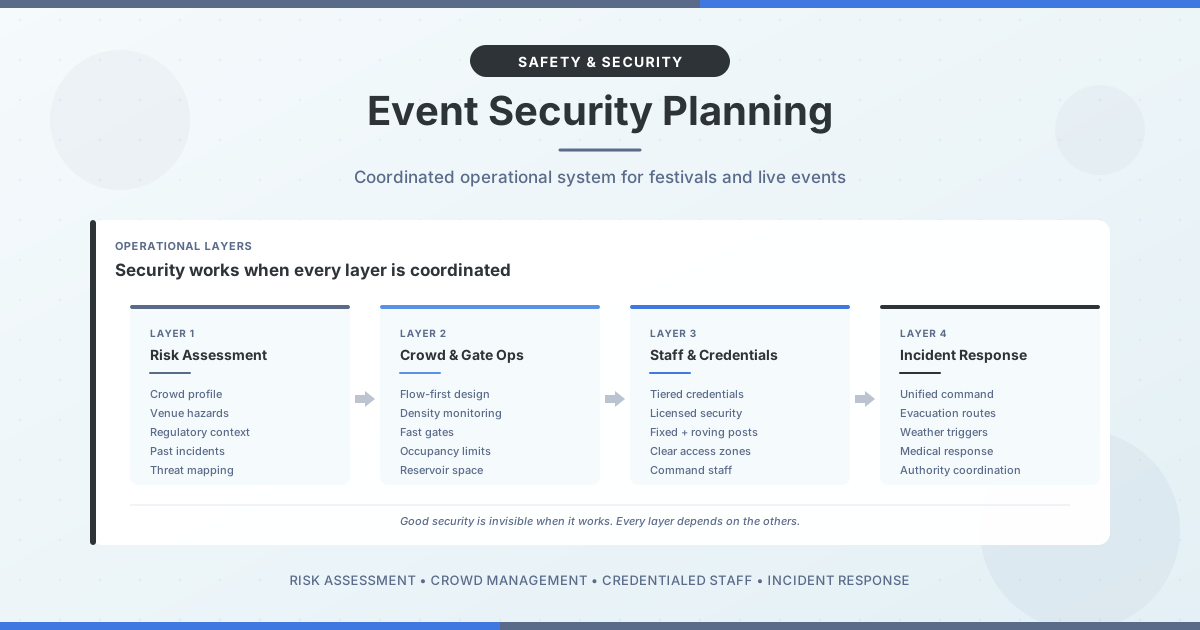
Security Is a Discipline, Not a Checklist
For festival and live event organizers, security is one of the highest-stakes areas of event planning. It's also one of the most commonly underdeveloped. Organizers spend months on lineup, marketing, and production, then approach security with a generic staffing plan and a vague intention to "have enough people." That approach leaves real gaps.
Good event security is a coordinated system. It connects crowd management, gate operations, staffing, credentialing, incident response, and coordination with local authorities. Each piece depends on the others. A fast gate reduces crowd pressure outside. A clear command structure turns a medical call into a managed response rather than a scramble. A well-credentialed staff means the right people can act quickly when something happens.
This guide covers the practical operational layers of event security planning. It's not legal advice, and it's not a substitute for working with experienced security professionals. For any significant event, engage a licensed security firm, coordinate with local law enforcement and fire officials, and review your plan with legal counsel and insurance providers.
Start with a Risk Assessment
Before tactical planning, start with an honest assessment of your event's specific risk profile. Generic security plans miss the risks that matter most for your particular event.
Questions worth answering before you plan:
- What's the crowd profile? Age, expected behavior, alcohol policy, seating vs. standing. A seated theater show has very different risks than a standing festival.
- What's the venue type? Indoor arena, outdoor field, urban street, multi-stage campus. Each has different evacuation, crowd flow, and access considerations.
- Who are your performers and speakers? Public figures sometimes attract additional attention, positive or negative. Factor that into threat assessment.
- What are the known hazards at this venue? Weather exposure, traffic patterns, sightline issues, chokepoints. Walk the venue in advance and identify them.
- What's the regulatory context? Local fire code, occupancy limits, alcohol permits, permitting requirements. Noncompliance creates both safety and legal risk.
- What's your history? If you've run this event before, what incidents have occurred, even minor ones? Past patterns predict future ones.
A thoughtful risk assessment drives every downstream decision. Skip it, and you end up with a security plan that looks comprehensive on paper but misses what actually matters for your event.
Crowd Management: A Discipline of Its Own
Crowd management and security overlap, but they're distinct disciplines. Security deals with threats. Crowd management deals with density, flow, and the conditions that cause crowds to become dangerous to themselves, regardless of any specific threat.
Core crowd management principles that belong in every event plan:
- Design for flow, not just capacity. Total venue capacity matters, but so does how attendees move through the space. Pinch points between stages, around food vendors, at bathrooms, and at merchandise all create local density problems even when overall capacity is fine.
- Monitor density in real time. For larger events, have trained observers (your security lead, operations manager, or a dedicated crowd manager) watching key zones throughout the event. Density problems develop fast and resolve slowly.
- Plan for high-anticipation moments. Headliner starts, gate opens, fireworks, meet-and-greets. Any moment that draws attendees toward a specific point is a crowd management event and deserves specific planning.
- Build in reservoir space. Don't fill a venue to maximum capacity and leave no room for the crowd to redistribute. Empty space is safety margin.
- Use signage and announcements proactively. If a section is getting dense, communicate alternative paths before the situation requires intervention.
- Respect occupancy limits. Fire marshal capacity limits exist for clear safety reasons. Never exceed them. This includes not selling more tickets than the venue safely holds and accounting for staff, vendors, and guest list in total count.
For multi-stage festivals or large events, consider engaging a professional crowd management specialist. The discipline has evolved significantly over the past decade, and organizations specializing in crowd dynamics bring expertise that general security firms often don't have.
Gate Operations: Speed Is a Safety Feature
Gates are where most event security incidents have their first failure points. Slow gates create frustrated crowds outside the venue. Frustrated crowds become aggressive crowds. Aggressive crowds create security problems. What looks like a capacity problem is often an efficiency problem.
The four S's of gate operations:
- Staffing. Calculate required staff based on expected arrival rate, not total attendance. If 10,000 attendees arrive over 2 hours, you need capacity for 5,000 per hour (roughly 80 per minute). That determines scanner count, wristband stations, and ID checkers needed per gate.
- Stanchions. Physical barriers that organize flow. Plan lane counts, queue length, and overflow space before doors open. Random crowds in front of a gate are far worse than organized lines of the same size.
- Signage. Clear, visible markers for GA, VIP, will-call, accessibility, re-entry, and prohibited items. Attendees who know where to go don't crowd the wrong lines.
- Scanning. Fast, reliable ticket validation. A scanner that processes 15 tickets per minute creates different density than one that processes 30. Every second counts.
The relationship between gate speed and security is direct. Faster gates mean less time outside the venue, which means smaller staging crowds, which means less pressure on security. The Eventpro scanning app from Big Tickets is built for this reality: fast scans, offline mode when connectivity fails, and real-time visibility into gate velocity across all entry points. For more on gate operations specifically, see our guide to ticket scanning and gate entry.
Big Tickets also provides on-site staffing services for some clients, including trained gate staff and scanner operators, for organizers who want a single operational partner rather than assembling a scanning team separately.
Credentials and Staff Identification
When something goes wrong at an event, attendees need to know who to trust and who to follow. That's a credential problem, not a personality problem. The best security staff in the world can't help if attendees can't identify them.
Principles for effective credentialing:
- Tiered credentials for staff, vendors, security, and talent. Color-coded or visually distinct badges with clear role identification. A security guard, a production staff member, and a vendor should be visually distinguishable at a glance.
- Harder to counterfeit than a printed jacket. For larger events, use laminated photo ID badges, RFID-enabled credentials, or other harder-to-forge options. Printed jackets and t-shirts can be copied in hours.
- Access zones matched to credentials. Not every staff member needs backstage access. Back-of-house, stage, talent areas, and command posts should have credential checks that enforce appropriate access limits.
- Badge collection at the end of shift. Lost or stolen credentials become real security problems the next event. Track and collect them systematically.
- Brief everyone on the credential system. Every staff member should know what every color and badge type means, and who has authority in which zones.
Security Staffing: Visible, Trained, and Coordinated
Visible security presence deters many issues before they start. That visibility has to be balanced; too heavy a presence signals to attendees that you expect trouble, which creates its own tension. The right balance varies by event type but usually includes:
- Entry screening staff. Bag checks, wand or walk-through screening, and ID verification at gates.
- Fixed-post security. Stationed at stages, VIP areas, backstage entries, and other sensitive zones.
- Roving security. Patrolling the venue, responding to issues, and providing visible deterrent in common areas.
- Command and control. A designated security lead coordinating all assets, typically based at a command post with direct communication to all security staff, venue operations, and external agencies.
- Plainclothes security (for some events). Some high-profile events supplement uniformed presence with plainclothes security who can respond to situations without the escalation that visible security sometimes causes.
Regardless of staffing level, training matters more than headcount. A small, well-trained, well-coordinated security team outperforms a larger team of inexperienced staff. Work with a licensed security firm with experience in live events, not general security providers who may not understand the specific dynamics of your event type.
Incident Response: Plan Before You Need It
Every event should have a documented incident response plan that covers the most likely scenarios. The plan doesn't need to anticipate every possible incident; it needs to establish the command structure and communication framework so the team can respond to whatever does occur.
What every incident response plan should include:
- Unified command structure. Who's in charge during an incident, who has authority to make which decisions, and how command coordinates with external agencies (police, fire, EMS). Ambiguity about who's in charge during a crisis is one of the most costly mistakes in event operations.
- Communication protocols. Radio channels, code words, announcement authority, and who speaks to press and attendees. During an incident, the worst thing you can do is have multiple uncoordinated messages going out at once.
- Evacuation procedures. Specific routes from every part of the venue, who directs attendees, how staff communicate the evacuation, and where attendees gather afterward. Rehearse this with staff before doors open.
- Shelter-in-place procedures. For severe weather, nearby incidents, or scenarios where evacuating is less safe than staying. Know in advance which spaces can serve as shelter and how to communicate that decision.
- Medical response. On-site medical staff, first aid stations, relationship with local EMS, and protocols for routine (heat, intoxication, injury) and serious incidents.
- Weather triggers. Specific criteria for lightning shutdowns, severe weather holds, heat emergencies, and how decisions are made and communicated to attendees.
- Incident documentation. Who records what happened, when, and how it was handled. Important for insurance, legal, and operational learning.
For significant events, run a tabletop exercise with key staff and external partners (local police, fire, EMS) in advance. Walk through several scenarios, test the command structure, and identify gaps. The best time to discover your radio channels don't work between venue security and local police is during the walkthrough, not during an incident.
Coordination with Local Authorities
For any meaningful event, work with local law enforcement, fire, and emergency management in advance, not on event day.
- Meet in advance. Most jurisdictions have a special events permit process that requires coordination. Use that process as an opportunity to brief local authorities on your event and understand their requirements.
- Share your plan. Local agencies should have a copy of your security and incident response plans before the event. Their feedback often catches gaps you'd miss otherwise.
- Establish communication channels. Dedicated radio channels, direct phone contact for command staff, and agreed-upon protocols for coordination during incidents.
- Know the thresholds. At what point does the event transition from your security team handling something to law enforcement taking over? Clear thresholds prevent confusion in the moment.
- Post-event debrief. Review what happened with local authorities after the event. Builds relationships for next time and captures operational lessons.
Ticket and Data Security
Physical security is the primary focus, but ticket integrity and data protection are real security concerns too. Fraudulent tickets create gate confusion. Data breaches create legal and reputational damage that outlasts the event.
- Use a PCI-compliant ticketing platform. Big Tickets is PCI DSS Level 1 compliant (the highest tier), so payment card data is handled according to the strictest security standards in the industry. Work with any ticketing partner only if they can demonstrate current PCI compliance.
- Fraud detection at purchase. Big Tickets includes fraud detection tools that flag unusual ticket purchase patterns, helping reduce chargebacks, scalping, and fraudulent resale activity before it affects your event.
- Unique ticket codes and duplicate detection. Scanning technology should immediately flag duplicate scan attempts, which is the most common form of ticket fraud at the gate.
- Clear policies on transfers and resale. Published terms for how tickets can be transferred or resold reduce disputes and help you enforce against obvious fraud.
- Data handling practices. Know what attendee data you collect, where it lives, who has access, and what happens to it after the event. GDPR, CCPA, and other regulations apply to event data too.
Pre-Event Walkthrough and Final Check
In the 24 hours before doors open, conduct a final walkthrough with your security lead, operations lead, and key staff. Purpose: identify anything that's not how the plan specified.
What to check:
- Every marked exit is unobstructed and accessible
- All signage is in place and legible
- Stanchions and barriers are positioned correctly
- Staff credentials are distributed and visible
- Communication equipment (radios, PA, mobile) is tested and working
- First aid stations are staffed and stocked
- Command post is operational
- Local authority contacts are confirmed
- Weather forecast is reviewed; any triggers for shutdown or hold are clear
The walkthrough is the moment the plan meets reality. It's rarely the thing you find that's the real discovery; it's the gap between what you planned and what the site actually looks like the day before gates open.
Good Security Is Invisible When It Works
When event security is well-planned and well-executed, attendees don't notice it. They move through fast gates, find their space, enjoy the event, and leave safely. The work that made that experience possible happened weeks and months in advance.
Start with risk assessment. Plan crowd management as a discipline distinct from security. Build gate operations that prioritize speed and clarity. Credential your staff so the right people are identifiable. Build an incident response plan and rehearse it with your team and local authorities. Maintain ticket and data integrity. And walk the venue one final time before doors open.
Security isn't a line item; it's a system, and the events that run safely are the ones where that system is thought about with the same seriousness as lineup, production, and marketing. The investment is never wasted.
Ready to Run a Smarter Event?
Big Tickets helps festivals, fairs, concerts, and live events sell more tickets, streamline operations, and deliver a better attendee experience. No subscriptions, no setup fees.
Request a Demo